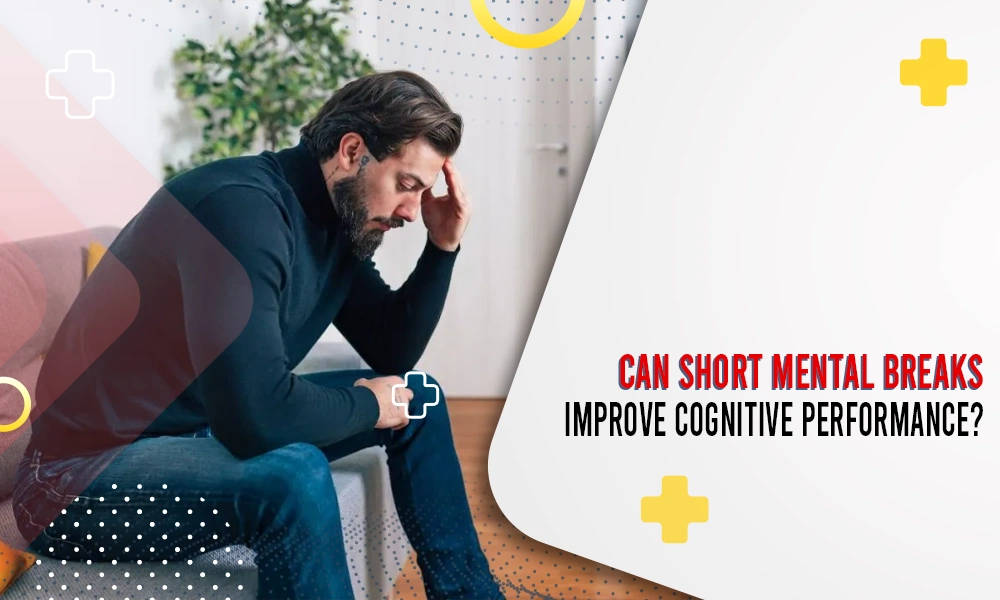
Do you ever find yourself reading the same paragraph several times trying to make sense of the words in front of you? No matter how many times you go over the same lines, they just don’t seem to register in your brain. We’ve all been there, and this doesn’t necessarily happen because you’ve consciously lost interest in the task in front of you. Granted that our brains are great at information processing, sometimes we all need a break.
I mean, just think about your phone. When you use it too much and have too many applications running, it can heat up pretty soon, and your battery may drain pretty soon. While your brain isn’t completely equivalent to a phone. Sometimes all we need is a break and to come back to something with a fresh set of eyes. Spending hours on end trying to juggle between tasks, conversations, meetings, and deadlines is bound to drain anyone and affect their cognitive performance. This is why short breaks can help so much. Rather than just trying to push through, taking mini breaks can help make tasks feel more manageable.
Attention Span During Prolonged Work Hours
Attention isn’t a tap that stays open. It’s more like a battery that drains while nobody’s looking. Psychologists call the slow slide a vigilance decrement, which is a fancy way of saying performance dips the longer someone stays locked onto one thing. Some lab work has found lapses showing up within 10 to 25 minutes, sometimes sooner.
That’s a short amount of time. Shorter than most meetings, honestly, and way shorter than the average study session. So cognitive performance doesn’t really crash. It leaks. A bit slower here, a missed detail there, and by mid-afternoon someone’s rereading the same email for the fourth time.
Mental fatigue and concentration tend to slide together, and the odd part is that the person living through it rarely notices the slope. It just feels like a bad day.
What Can Cause Attention to Drop?
It’s hard to pin the reason to one cause, and researchers themselves admit the literature isn’t settled on exactly what causes the drop in an individual’s alertness. Cognitive load is one explanation. The theory states that our working memory stores can only hold a certain number of chunks of information. Working memory can only hold so much, and a long stretch of passive input fills it up. The theory states that holding more information than what is usually held in the working memory can easily lead to a kind of cognitive overload, confusion, and a failure to learn and perform the required tasks.
Boredom can play a part too. Distractions like our phones can cause a huge amount of attention drain for us. Apps are increasingly being built to hold as much of our attention as possible. Whatever the mix of reasons is, a person’s cognitive performance takes the hit, and it takes it quietly.
What’s less up for debate is the practical side of brain fatigue and productivity. A tired brain makes slower, sloppier calls, and the work takes longer than it should. Taking longer and not being efficient during each task is what actually kills the day, not the break.
Research Evidence for the Benefits of Short Breaks
A 2025 study in Frontiers in Psychology looked at 253 undergraduates and tried something simple. One group got a traditional ten-minute break halfway through a long class. The other group got roughly 90 seconds off every ten minutes or so, then quizzes.
The micro-break group did better. Not only better, but also steadier. Both groups slid downhill as the session went on, which is normal, but the micro-break students slid more slowly. The long break gave a quick bump right after it, and then the bump faded.
It’s important to note that these were university students, not accountants in a quarterly close, and nobody tested what stuck a week later. Quiz scores also aren’t the same thing as cognitive performance in an office, though they’re a decent stand-in. So the memory side is still a guess.
The researchers tied it to spaced learning, the old idea that information holds better when it’s taken in chunks with gaps in between, which makes sense. Gaps give the brain a moment to actually process what just went in instead of stacking more on top.
How Helpful Are Short Breaks in Regular Jobs?
Here things get a little less exciting. A meta-analysis pulling together 22 samples and roughly 2,335 participants found that short breaks gave small but real boosts in energy and lowered fatigue. The keyword here is small. Nobody’s becoming a genius over a two-minute rest.
Still, the benefits of taking mental breaks don’t have to be huge to be worth it. A little more energy, a little less drag, repeated across a whole week can add up and help improve an individual’s productivity.
And there’s the angle of cognitive performance and productivity together, which people like to treat as the same thing when they aren’t quite. Productivity is output. Performance is how well the thinking holds up while that output happens. A person can grind out hours of work with poor thinking quality, and the mistakes show up later, in the redo pile.
One 2026 review looked at interrupting long sitting with standing or light movement and saw small, short-lived gains in memory and executive function (planning, switching between tasks, that kind of thing). A short-lived lift in cognitive performance, basically. But the certainty of the evidence was rated low.
What Counts As a Short Mental Break?
Not all breaks are equal. Scrolling a phone for three minutes feels like rest, but the brain’s still taking in fast, fragmented input. While you might think that you’re resting your brain, it’s not actually the reset that you seem to think it is, your brain is still engaged.
Stuff that seems to work better is uninteresting on purpose. Stuff like looking out a window, standing up from your seat, filling a water bottle, taking a short walk down the hallway, and taking your eyes off the screen for a bit can all help. The 20-20-20 rule gets mentioned a lot: every 20 minutes, look at something about 20 feet away for about 20 seconds. Eye doctors suggest it, and it’s easy enough to try.
Some researchers also point out that minds wander on their own every few minutes anyway, so a pause gives that wandering somewhere to go. Which is kind of funny. The brain was already taking breaks without asking.
What protects cognitive performance more, a proper screen-free pause or a quick glance at notifications? Almost certainly the first one.
Effects of Short Breaks on Memory
While everyone is busy talking about an individual’s focus and attention, sometimes we fail to factor in an individual’s memory too. A huge part of a person’s productivity is also their memory, not just how attentive and adept they are at the given task. The information that goes in during a foggy stretch tends not to hold well, and reading something while half checked out is close to not reading it.
Short pauses may give new material a little room to settle. The evidence for lasting memory is thinner than the evidence for in-the-moment attention, to be fair, so claims that breaks “lock in” learning are a stretch. Cognitive performance in the moment is the better-supported benefit right now.
And work breaks and cognitive health as a bigger, long-term topic deserve their own look. Chronic stress, shift work, and long hours were all flagged by a 2024 systematic review as things that can wear down different parts of thinking, and microbreaks came up as one possible way to protect it. It’s one possible way, not a cure for a bad schedule.
Medications for Supporting Wakefulness
Now that we’ve gone over the merits of short breaks as a lifestyle approach, there are situations where just the short breaks won’t suffice, times when the difficulty in concentrating is brought on by underlying conditions rather than just a demanding work schedule. Factors like excessive and persistent sleepiness during the day, irregular sleep schedules, and sleep disorders like narcolepsy can take a toll on someone and make it difficult for them to stay awake during even the simplest of tasks.
This is when medications enter the picture to help an individual stay awake during the day or their required shifts. Modafinil is a famous ingredient in the wakefulness market that’s present in several wakefulness medications like Modalert 100 mg and Modalert 200 mg. These medications are specifically recommended to individuals to encourage wakefulness so that they can tackle sleep conditions like narcolepsy or obstructive sleep apnea (OSA).
The primary goal of these meds is to work on the excessive daytime sleepiness that a person experiences, work on the person’s dopaminergic system, and help them stay awake for their daytime activities. Individuals can also have an increased concentration after taking the medications. Despite the pros of the ingredient, it should never work to replace proper rest, healthy work habits, and a consistent sleep schedule that every person should maintain.
Final Thoughts
Despite how rejuvenating short breaks seem to be, make sure that you don’t turn them into a necessary chore. Here’s the trap. Breaks turn into a system, the system turns into an app, the app sends reminders, and suddenly resting is a task on the list.
The simpler version is to pick a rhythm that roughly matches the work. Intense task, shorter stretches. Easy tasks, longer ones. A minute or two off every ten to thirty minutes lines up with what researchers have actually tested, though nobody has found one magic number.
And it’s fine if it’s imperfect. Some days the break happens at minute 50 instead of minute 25. Whatever. The aim is steady cognitive performance, not a flawless schedule, and it isn’t going to fall apart over a late pause. The bigger shift is just not treating stopping as failure. A short pause is part of the work, not a gap in it.
What is sleep paralysis?
Sleep paralysis is a temporary inability to move or speak while falling asleep or waking up. The person is awake, or mostly awake, but the body is still locked in the muscle shutdown that normally belongs to dreaming sleep. That’s about it. Nothing is damaged, nothing is “wrong” with the muscles themselves. It’s a timing problem between two systems that usually hand off smoothly.
The condition has been described for centuries, and almost every culture has a story for it. Night hags, pressing demons, old spirits sitting on the chest. Reading those older accounts, the descriptions match modern clinical reports surprisingly well, which suggests people were describing the same biological event and just explaining it with whatever framework they had.
Researchers sometimes split it into two rough groups. Isolated sleep paralysis happens on its own, without any other sleep disorder. Recurrent episodes can show up as part of narcolepsy, where the sleep-wake boundary is generally unstable. The distinction matters because the first is usually harmless and the second deserves proper medical attention.
Sleep paralysis symptoms
The core symptom is sudden muscle weakness during sleep, or more accurately right at the edge of sleep, where the limbs, trunk and often the voice simply won’t work. Breathing continues, because the diaphragm and the muscles that keep it going are spared, though people often report a heavy feeling in the chest that makes it seem otherwise. Eye movements also stay intact, which is why people can look around the room.
Other sleep paralysis symptoms tend to cluster around the fear response. A racing heart, a sense of dread, sweating, a feeling of being watched, an urge to scream with nothing coming out. Some people feel pressure or a sensation of being pulled or touched. Episodes usually end on their own, or when someone nearby touches or speaks to the person, or when the person manages a small movement like a finger twitch. After that, there can be lingering anxiety, and a few people become nervous about going to bed at all, which is its own problem, since that worry feeds into worse sleep.
The hallucination part
Not everyone has them, but sleep paralysis hallucinations are the most disturbing piece for a lot of people. They tend to fall into three flavours. One is the sense of an intruder, a shape or a presence in the room. Another is pressure on the chest, sometimes with a feeling of choking. The third involves floating or out-of-body sensations, which some people find oddly pleasant and others find terrifying.
The likely explanation is fairly plain. The brain is generating dream imagery while also taking in real sensory input from the bedroom, so dream content gets overlaid onto the actual room. The threat-detection circuits, particularly the amygdala, are active in REM sleep, and the brain, already on high alert because it can’t move, interprets ambiguous signals as danger. Put a frightened brain in a dark room with dream images leaking into waking vision and the “figure in the corner” starts to make more sense. It isn’t a sign of psychosis, although a few studies link frequent episodes with higher stress and anxiety.