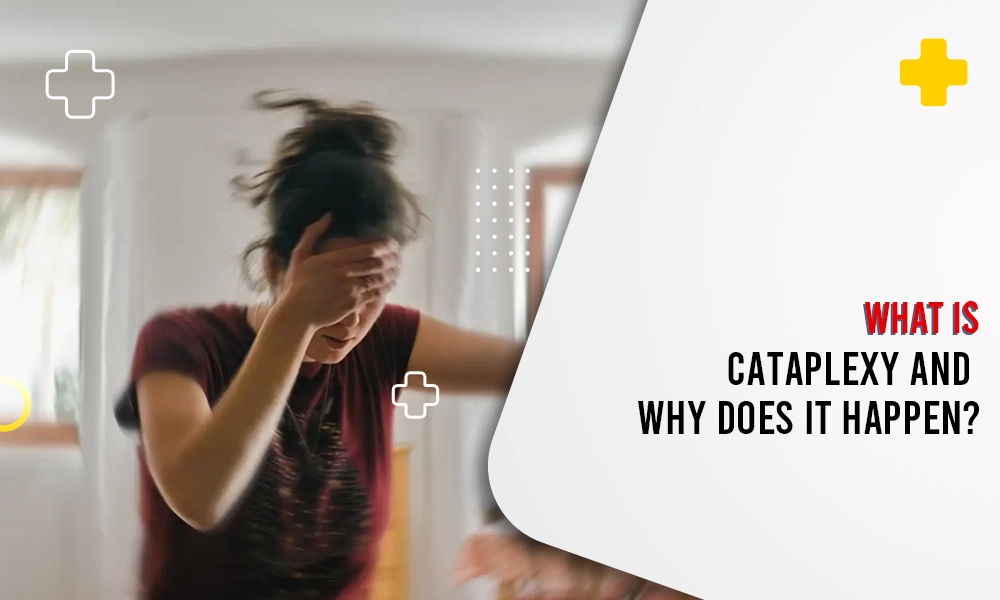
There’s a moment that happens to some people that sounds almost fake when you describe it out loud. They’re laughing at something-really laughing, nothing dramatic and then their knees just go. Or their jaw drops open, head tips forward, and for a second or two their whole body just stops holding itself up. Then it passes and they’re fine. Standing there like nothing happened. That’s cataplexy.
Let’s learn more about it in the article.
What is Cataplexy?
Cataplexy is the sudden, brief loss of muscle tone while remaining fully conscious which is usually triggered by strong emotions, mostly the positive ones like laughing or being surprised by something funny. It is a physical feature of Narcolepsy, especially Narcolepsy type 1. The connection between Narcolepsy and Cataplexy are close enough that physicians use it as one of the main clues when trying to figure out if someone actually has narcolepsy or something else entirely.The episodes usually last for a few seconds to two minutes. Episodes vary from mild to complete physical collapse.
Why does it actually happen?
This is where things get murky. The leading explanation involves a loss of brain cells that produce a chemical called hypocretin which is also called orexin. Hypocretin helps keep wakefulness and REM sleep properly separated.
Normally, during REM sleep your muscles go into a kind of paralysis. That’s actually protective-it stops you from physically acting out whatever is there in your dreams. The connection between REM sleep and muscle control is really the core of everything. With cataplexy, REM related paralysis mechanism seems to intrude into waking hours. An emotional spike acts like a trigger and the brain briefly does its REM muscle-shutdown routine while the person is standing there wide awake.
Why the hypocretin neuron disappeared in the first place is still being worked upon. Autoimmune involvement is the strongest theory right now- the body attacking its own neurons, possibly set off by an infection at some earlier point, though this isn’t confirmed in every case. Genetics seems to play some part too. If you’re hoping for one of those tidy, complete neurological causes of sudden muscle weakness explanations, this isn’t really it.
What are the symptoms?
Symptoms vary a lot, which is honestly one of the most confusing things about this condition. For some people it’s milder like droopy eyelids, a slack jaw, knees that feel wobbly for a second or two. For some, it is a full collapse, where they end up on the floor, completely conscious, unable to move while people around them assume something far more serious is happening.
Common emotional triggers for sudden muscle weakness include laughing, being startled, anger, even just enjoying a joke you told yourself. Some people mention it during arguments, during sex, watching something unexpectedly funny. Episodes typically last a few seconds up to a couple minutes, rarely longer than that. But even a short episode at the wrong moment like near the stairs, crossing a street, holding something hot can be genuinely risky.
Excessive daytime sleepiness can exist on its own in Narcolepsy, totally apart from the Cataplexy episode. How disrupted sleep really affects daytime functioning is really its own subject- fragmented sleep chips away at memory, mood and reaction time. The effects of poor sleep on concentration show up in people who do not have narcolepsy at all, just from ordinary bad sleep. But when cataplexy is part of the bigger picture; it’s not simply about being tired. The relationship between sleep quality and mental focus gets disrupted at the deeper level, because the brain’s usual system for separating sleep and wake states isn’t functioning properly to begin with.
How is it diagnosed?
Diagnosis usually starts with the person’s history- when episodes happen, what seems to set apart, how long they last, what are the symptoms and whether there’s any pattern to it. After this, physicians usually move to a sleep test sometimes paired with something called MSLT (Multiple Sleep Latency Test) which measures how quickly someone falls asleep during the day. In some cases, hypocretin levels are tested through spinal fluid, though that’s not done everywhere and isn’t always necessary if the clinical picture is already fairly clear.
It can take years for somebody to actually get diagnosed. Episodes get written off as fainting, anxiety, clumsiness especially in kids where cataplexy can look subtler than the dramatic collapse people expect. A slight facial droop or a stumble might be the only visible sign, and that’s easy to miss or misread entirely.
Treatment
There’s no official treatment for this. Management is really the goal-medications that affect REM sleep regulation are commonly prescribed and they can meaningfully reduce how often episodes happen. Beyond medication, a lot of it comes down to lifestyle adjustments: keeping a consistent sleep schedule, managing stress levels, sometimes being more cautious around known triggers, though realistically you can’t ask someone to just stop laughing or avoid excitement altogether.
There are medications for Narcolepsy such as Modalert 100 mg, Modalert 200 mg, Modacare 400 mg which consist of Modafinil, a wakefulness medication. Some people end up unconsciously suppressing emotional reactions just to avoid triggering an episode like holding back a laugh, not letting themselves get too worked up about something good happening. It works, sort of, as a coping mechanism, but it takes its own toll over time that’s separate from the physical symptom itself.
Complications
The physical risk during an episode is the most obvious complication- falls, injuries, being in a vulnerable position at the wrong moment. But there’s more to it than that. Misdiagnosis is a recurring problem, partly because cataplexy is rare enough that a lot of general physicians might only encounter a handful of cases across their whole career life.
There’s also the emotional and social side that doesn’t get much talked about. Constantly managing or dampening your reactions to avoid an episode can affect relationships, work situations and general quality of life. And because narcolepsy with cataplexy often disrupts nighttime sleep too, not just daytime alertness, people can end up dealing with a kind of layered exhaustion like poor sleep at night, unpredictable episodes during the day, and the mental load of trying to manage both.
Where the Research still falls short
The connection between REM sleep and muscle control keeps showing up as the central thread in most of what’s understood about cataplexy but there are still real gaps. Why some people with narcolepsy never develop cataplexy at all. Why severity swings so much between individuals. Why certain emotions seem to trigger it more reliably than others. Some of that might just come down to individual variation in how sensitive a person’s system is, though that’s more of an educated guess than a settled answer.
It’s one of those conditions that sounds almost made up until you actually witness it that the body is doing something it was already built to do during sleep, just misfiring into a completely wrong moment.
Frequently Asked Questions
1. Is cataplexy the same as fainting?
No. The person stays fully conscious the whole time, even though their muscles go weak or give out.
2. Can cataplexy occur without narcolepsy?
It’s uncommon, but isolated cases without full narcolepsy have been documented.
3. What usually triggers an episode?
Strong emotions like laughing, surprise, excitement are the most common triggers for an episode.
4. How long does an episode typically last?
Usually a few seconds to a couple of minutes, though it can feel much longer in the moment.
5. Is there a cure for cataplexy?
No cure currently exists, but medication and lifestyle changes can help reduce episodes.