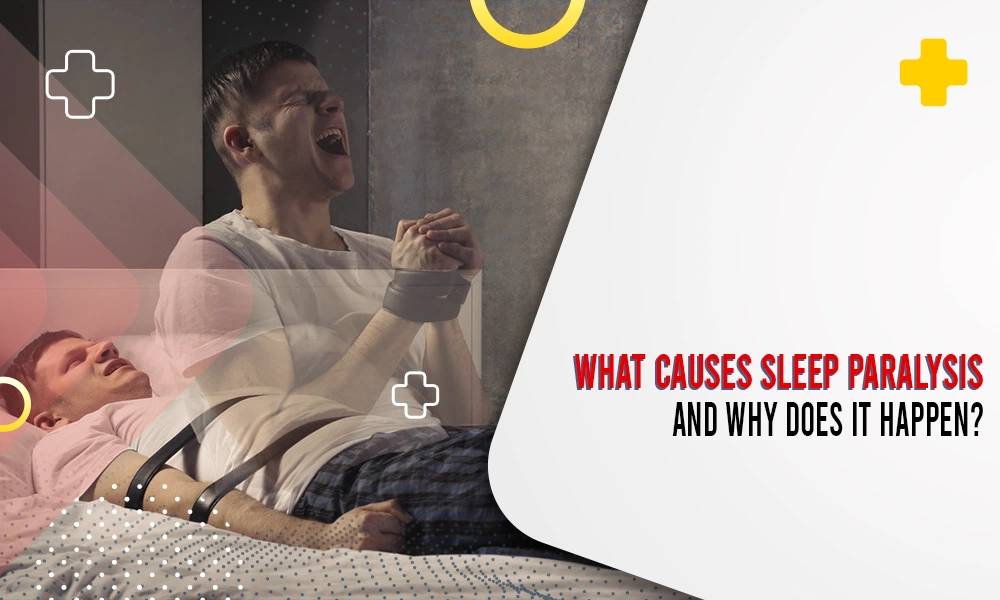
Imagine waking up at a random night and not being able to move, talk or respond. Feels frightening right? This is what sleep paralysis does to a person. The eyes open, the room looks normal and yet the body just doesn’t respond. It lasts seconds, sometimes a couple of minutes, though it feels much longer for the person who is actually dealing with it. Somewhere around a third of people experience it at least once, which is a lot more than most would guess, and that alone says something about how ordinary the mechanism behind it really is.
What is sleep paralysis?
Sleep paralysis is a temporary inability to move or speak while falling asleep or waking up. The person is awake, or mostly awake, but the body is still locked in the muscle shutdown that normally belongs to dreaming sleep. That’s about it. Nothing is damaged, nothing is “wrong” with the muscles themselves. It’s a timing problem between two systems that usually hand off smoothly.
The condition has been described for centuries, and almost every culture has a story for it. Night hags, pressing demons, old spirits sitting on the chest. Reading those older accounts, the descriptions match modern clinical reports surprisingly well, which suggests people were describing the same biological event and just explaining it with whatever framework they had.
Researchers sometimes split it into two rough groups. Isolated sleep paralysis happens on its own, without any other sleep disorder. Recurrent episodes can show up as part of narcolepsy, where the sleep-wake boundary is generally unstable. The distinction matters because the first is usually harmless and the second deserves proper medical attention.
Sleep paralysis symptoms
The core symptom is sudden muscle weakness during sleep, or more accurately right at the edge of sleep, where the limbs, trunk and often the voice simply won’t work. Breathing continues, because the diaphragm and the muscles that keep it going are spared, though people often report a heavy feeling in the chest that makes it seem otherwise. Eye movements also stay intact, which is why people can look around the room.
Other sleep paralysis symptoms tend to cluster around the fear response. A racing heart, a sense of dread, sweating, a feeling of being watched, an urge to scream with nothing coming out. Some people feel pressure or a sensation of being pulled or touched. Episodes usually end on their own, or when someone nearby touches or speaks to the person, or when the person manages a small movement like a finger twitch. After that, there can be lingering anxiety, and a few people become nervous about going to bed at all, which is its own problem, since that worry feeds into worse sleep.
The hallucination part
Not everyone has them, but sleep paralysis hallucinations are the most disturbing piece for a lot of people. They tend to fall into three flavours. One is the sense of an intruder, a shape or a presence in the room. Another is pressure on the chest, sometimes with a feeling of choking. The third involves floating or out-of-body sensations, which some people find oddly pleasant and others find terrifying.
The likely explanation is fairly plain. The brain is generating dream imagery while also taking in real sensory input from the bedroom, so dream content gets overlaid onto the actual room. The threat-detection circuits, particularly the amygdala, are active in REM sleep, and the brain, already on high alert because it can’t move, interprets ambiguous signals as danger. Put a frightened brain in a dark room with dream images leaking into waking vision and the “figure in the corner” starts to make more sense. It isn’t a sign of psychosis, although a few studies link frequent episodes with higher stress and anxiety.
Frequently Asked Questions
1. Is sleep paralysis dangerous?
No, it’s frightening but not harmful on its own. Breathing continues normally throughout.
2. How long does an episode last?
Usually a few seconds to a couple of minutes. It can feel much longer.
3. Can stress trigger it?
Yes, stress and anxiety are commonly linked with more frequent episodes.
4. Can it be prevented?
Keeping regular sleep hours, getting enough rest and treating any sleep disorders that exist.
5. What are the early signs of sleep paralysis?
Symptoms include sudden muscle weakness, inability to move or speak, vivid hallucinations, etc.