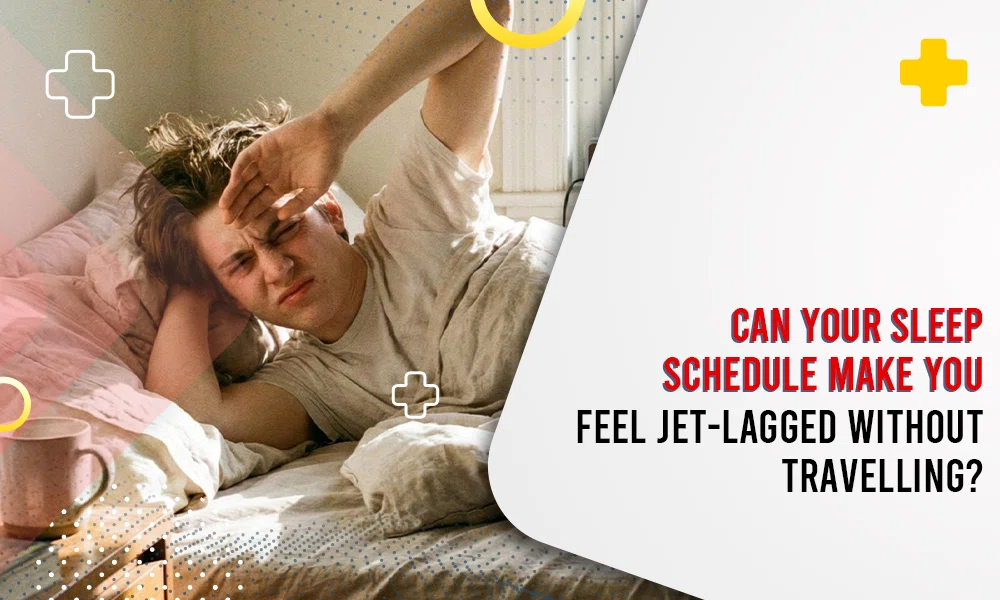
Monday, 6:30 a.m. The alarm goes off and your whole body feels like it has just come off a night flight from somewhere far away. Except nobody went anywhere. No airport, no passport, no time zone crossed, only a sofa, a flat and a weekend that ran a bit late.
Strange, but not imaginary. Chronobiologists have a name for it, social jetlag, and the term came out of Munich, from Till Roenneberg and colleagues in the mid-2000s. The idea is almost embarrassingly simple. Work days follow the alarm clock, free days follow the body clock, and the gap between the two behaves like a time difference. Plenty of people in Germany cross that gap every week without noticing, which might be part of why so many are still not quite arrived by Tuesday.
Jet lag without a plane?
Jet lag is, at its core, a timing problem. The internal clock says one thing, the outside world says another. That is all. A tiny cluster of cells in the hypothalamus, the suprachiasmatic nucleus, keeps rhythms ticking at roughly 24 hours (slightly longer than that in most people, around 24.2, give or take), and light entering the eyes nudges it back into line each day. Fly from Frankfurt to Singapore and the nudge arrives hours too late, so everything feels wrong for days: appetite, mood, concentration, the lot.
Take someone who has a sleep schedule of 11 p.m. to 6:30 a.m. on weekdays, then 2 a.m. to 10 a.m. on Saturday and Sunday. The midpoint of sleep moves by about three hours. Weekend sleep schedule changes of that size are roughly what a trip from Berlin to Dubai does in winter, and then the return flight lands on Sunday night. Every week. For years, in some cases. It sounds exaggerated, and maybe it is a little, since real travel also brings dry cabin air, cramped seats and bad food, but the clock part is genuinely similar.
Social jetlag
In the original work, the midpoint of sleep (halfway between falling asleep and waking up) on work days was compared with the midpoint on free days. The difference is the social jetlag. Large survey data suggested that a big share of people in industrialised countries sit at an hour or more, and a smaller group at two hours or more.
Night owls tend to get the worst of it, because an early alarm fights a clock that naturally runs late. Teenagers are a similar story, since adolescent biology drifts later for a few years and then school starts at 7:45 regardless. It was never going to end well. An irregular sleep schedule is not simply about being disorganised, then, which is the usual assumption. Often it is biology colliding with a timetable.
Why Monday hurts more than Saturday
Sunday night is where the trouble tends to start. Sleeping until late morning delays the first dose of daylight, and light is the main signal (the “zeitgeber”, for anyone who likes the German word) that sets the clock. Melatonin then rises later in the evening than the wall clock would like. Falling asleep at 11 p.m. doesn’t work very well, the night turns out short, and the alarm goes off while the body clock still believes it is the middle of the night.
Core body temperature normally bottoms out a couple of hours before natural waking time. Being dragged out of bed near that low point produces the heavy, foggy state called sleep inertia, which can last from a few minutes to a couple of hours depending on the person. A body clock out of sync with the calendar does exactly this, week after week.
Among the usual causes of morning tiredness (alcohol, a warm bedroom, a snoring partner, late screens) the timing piece gets mentioned less often than it should. Or perhaps it deserves to sit first on the list. Then again, a noisy bedroom is hardly nothing either, so it is probably several things at once.
Tired even though the hours add up
A common puzzle: eight hours logged on the fitness watch, still shattered. Feeling tired despite enough sleep confuses people because duration is the only number anyone looks at. Timing matters too, and so does consistency. Sleep taken at the wrong biological time seems to be lighter and more broken up (the evidence is a bit mixed on the details), and the clock’s own alerting signal, which normally builds through the day, may be out of place.
In 2017 a Harvard-led study of university students found that those with irregular sleeping patterns tended to have later circadian timing and poorer academic results, even when total sleep was not wildly different. Correlation, yes, and still interesting. Even modest sleep-wake cycle changes, an hour here and there, seem to add up in the data, although where exactly the threshold sits isn’t clear. Probably it differs between people, as most things in this field do.
Sleep debt, or just bad timing? Both, probably
Plain sleep loss muddies the picture further. Weekday nights of six hours and weekend nights of nine create a kind of seesaw, and a sleep schedule that swings like that makes it hard to say which part is doing the damage. Sleep deprivation and daytime fatigue obviously go together. The repayment part is less obvious.
A small laboratory study from Colorado, published in 2019, found that weekend recovery sleep after a week of short nights did not prevent metabolic disturbances, and some measures worsened once the short nights started again. The sample was a few dozen people, so caution is sensible. Still, the old idea that the weekend wipes the slate clean looks a bit optimistic. Or only partly clean. Catching up does seem to help how people feel, at least for a day or so, which complicates the message.
The health bit, briefly
Observational studies link larger social jetlag with higher body weight, lower mood and worse cardiometabolic markers. These are associations, not proof. Late-night eating, less daylight, more alcohol on Fridays and so on travel together with late sleep, and separating them is difficult. The honest summary is that the clock matters, and the size of the effect on any one person is hard to pin down.
The clock change on 25 October
Timing is worth thinking about right now, actually. Clocks in Germany go back an hour on Sunday 25 October, less than two weeks away. One hour sounds trivial. The autumn change is usually seen as the gentler one, an extra hour in bed, but body clocks don’t read the news, and some people feel off for several days. A person with an already patchy sleep schedule starts from a worse place. The EU voted in 2019 to end seasonal clock changes, and nothing has happened since, so the twice-yearly shift carries on regardless.
What seems to help, in no particular order
Waking at roughly the same time every day, within an hour or so, appears to matter more than bedtime, mostly because people can’t command themselves to fall asleep but can set an alarm. Morning daylight, outdoors if possible, even on grey November days, since outdoor light on a dull day is still far brighter than most offices. Dimmer lights in the evening.
Caffeine has a half-life of around five to six hours, so a coffee at 4 p.m. is still half there at 10 p.m. Alcohol helps with dozing off and then fragments the second half of the night. If the weekend lie-in is non-negotiable, keeping it to about an hour is a gentler compromise than three. A short nap, 20 minutes or so before mid-afternoon, tends not to harm night sleep much. Shifting the sleep schedule by 15 to 30 minutes every few days works better than a hard reset on Sunday evening, though that is slower and rather boring.
Maybe it’s not the sleep schedule at all
Persistent tiredness that doesn’t lift after the sleep schedule has been steady for a few weeks deserves a proper look. Sleep apnoea, thyroid problems, iron deficiency, depression and certain medicines all produce the same morning fog, and no amount of regular bedtimes fixes those. A physician can sort it out with a few tests.
So, jet lag without travelling. In the sense that matters, yes. The body clock can’t tell a long-haul flight from a Friday night that ran into Saturday morning, and it sends the bill on Monday.
Frequently Asked Questions
1. Can an irregular sleep schedule really cause jet lag symptoms?
Yes. Shifting bedtimes and wake times can mimic jet lag, which researchers call social jetlag.
2. How long does it take to recover from social jetlag
Often a few days of steady wake times, though it varies from person to person.
3. Is sleeping in on weekends always bad?
Not always. A lie-in of about an hour is usually fine, while bigger gaps cause most of the trouble.
4. Why does tiredness persist after eight hours of sleep? Timing, quality and consistency matter alongside duration, and a medical cau
Timing, quality and consistency matter alongside duration, and a medical cause is possible too.
5. When should someone see a physician?
If tiredness lasts several weeks despite regular sleep, or comes with heavy snoring, breathing pauses or low mood.