Walk into any pharmacy in Berlin or Munich and there’s a shelf of it. Gummies, sprays, tiny tablets, fast-dissolve strips. The assumption behind all of it is that melatonin works like a mild sleeping pill, and that isn’t quite how the biology goes. It’s closer to a messenger, a note passed around the body saying it’s dark out, so maybe start winding down. Whether the note actually gets read depends on a lot of other things, which is the interesting part, and also the part that gets skipped on the packaging.
What is melatonin?
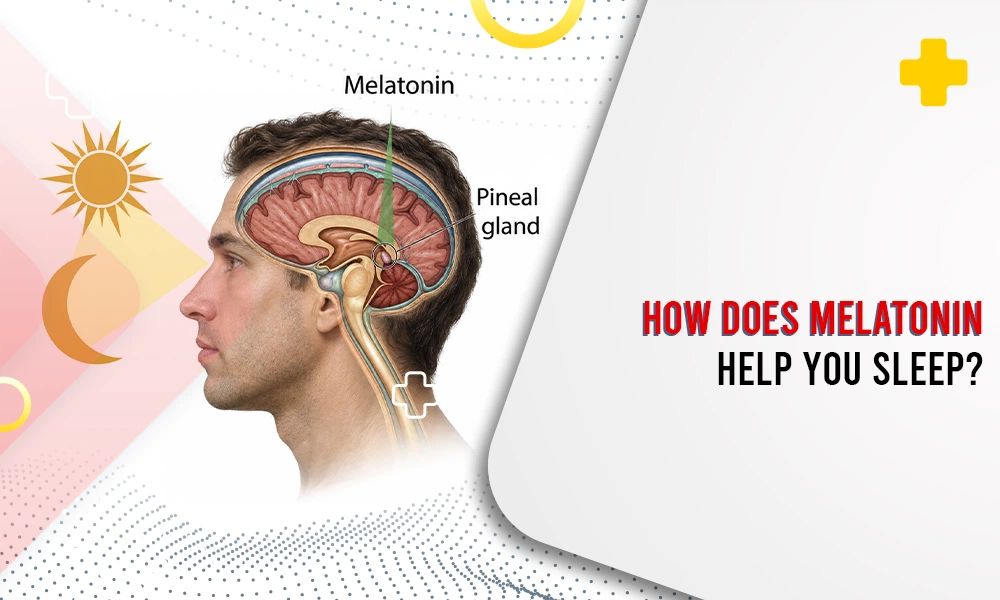
Melatonin hormone is made mostly in the pineal gland, a small pinecone-shaped structure deep in the brain. Pinecone, pineal, the name is literal. The raw material is tryptophan, an amino acid from food, which becomes serotonin during the day. Serotonin is then converted into melatonin through a couple of enzyme steps, and the last of those steps runs faster in darkness. So the chemistry already leans toward night before anything else gets involved.
Light is really the whole story. The retina contains a special set of cells, intrinsically photosensitive retinal ganglion cells if you want the full name, that hardly contribute to vision at all. They measure brightness, and they’re most sensitive to blue-ish light around 480 nanometres. They send that information to a tiny cluster of neurons in the hypothalamus called the suprachiasmatic nucleus, the SCN, which acts as the body’s master clock. In daylight the SCN keeps the pineal gland quiet. When light fades, the brake releases. That’s the simple version anyway, and the simple version leaves out plenty.
How does the sleep hormone regulate the sleep cycle?
People expect an on/off switch here, and it doesn’t work that way. Blood levels of the hormone stay very low through the day, close to undetectable, then begin climbing roughly two hours before someone’s usual bedtime. Researchers call this dim light melatonin onset, and it’s one of the standard markers of where a person’s internal clock sits. Levels peak somewhere in the middle of the night, often between 2 and 4 a.m., and slide back down toward morning as light returns.
So how the sleep hormone regulates the sleep cycle is mostly a matter of timing rather than force. It tells the body what biological time it is. There are receptors for it, MT1 and MT2, sitting in the SCN and other tissues. MT1 seems to quiet the clock’s daytime alerting signal, while MT2 is more involved in shifting the clock’s phase. Something else happens too. The hormone encourages blood vessels in the hands and feet to widen, which lets heat escape, and core body temperature drops. Sleep tends to begin more easily on a falling temperature. That link is reasonably well supported, though it’s not as neat as textbooks sometimes make it look.
Role of hormones in regulating the sleep-wake cycle
The role of hormones in regulating the sleep-wake cycle is more like a relay race with runners who overlap. Cortisol rises sharply in the early morning, peaking about 30 to 45 minutes after waking, then falls through the day and bottoms out around midnight. The two roughly mirror each other, one high when the other is low.
Then there’s adenosine, which is technically not a hormone but a by-product of brain activity that accumulates the longer someone stays awake. This is sleep pressure. Caffeine blocks adenosine receptors, which is why coffee makes people feel alert without changing the clock at all. So there are really two systems running together, the circadian clock, which handles timing, and the homeostatic drive, which handles pressure. Sleep comes most easily when both point the same way. Growth hormone adds another layer, pulsing during deep sleep early in the night, and appetite hormones like leptin and ghrelin drift out of balance after poor sleep. The full picture is still being worked out, honestly, and any article claiming it’s fully mapped is overselling it.
How the body prepares for nighttime sleep
Preparation starts well before anyone gets into bed. Core temperature peaks in the late afternoon or early evening and then starts falling. Heart rate and blood pressure ease down a little. Digestion slows. As evening light dims, the pineal gland ramps up.
There’s an odd detail in here that tends to surprise people. A couple of hours before habitual bedtime there’s a stretch called the wake maintenance zone, where alertness actually rises for a while, a last push from the clock before it lets go. That might explain the second wind so many people get up at 8 or 9 p.m. and then can’t sleep at 10. Or it might not, since individual variation is huge, and some people never notice it at all. Anyway, once that window closes and the alerting signal drops, the conditions for sleep are mostly in place, assuming nothing interferes. Which brings up the problem.
Light, mostly. Screens, especially.
Evening light is the biggest single disruptor. Lab work out of Harvard found that blue light suppressed the hormone for roughly twice as long as comparable green light, and shifted the circadian clock by about three hours compared with one and a half. Later studies showed ordinary room lighting in the evening, not just screens, can cut the release noticeably and shorten its duration. It’s not only phones and laptops, then. Overhead lights count too, particularly bright white LEDs.
That said, the size of the effect varies a lot between people, and there’s real debate about how much a phone held at arm’s length does compared with a bright ceiling light. Content on the screen probably matters as well, since a stressful email thread wakes the brain up in ways unrelated to wavelength. Dimming lights and using warmer bulbs after sunset is a low-cost move that has decent evidence behind it, even if the exact benefit is hard to pin down.
Ultradian rhythm and sleep quality
Circadian rhythm gets almost all the attention, but there’s a shorter layer underneath. Ultradian rhythms repeat more than once per day, and the best-known example is the roughly 90-minute cycle that sleep moves through, from light sleep to deep slow-wave sleep to REM and back around. A typical night holds four to six of these cycles. Early ones are heavy on deep sleep, later ones lean toward REM.
The connection between ultradian rhythm and sleep quality mostly comes down to whether the cycles stay intact. Alcohol, noise, sleep apnea, a snoring partner, a room that’s too warm, all of these chop the cycles up. Total time in bed might look fine on a tracker while time in deep sleep and REM quietly shrinks, which is why eight hours can feel like five. Melatonin sits upstream of all this. It doesn’t build the cycles directly, but it helps set the stage with stable timing, a lower core temperature and reduced alerting signals, so the cycles can run without constant interruption. There’s also a suggestion that a similar 90 to 120 minute rhythm runs through the daytime, affecting focus and energy dips, though that evidence is thinner, so it’s worth holding loosely.
Natural ways the body promotes restful sleep
Left mostly alone, the body already has a fairly elegant system. Morning light anchors the clock, and even an overcast sky outdoors delivers far more light than a typical indoor room, thousands of lux against a few hundred. Daytime activity raises sleep pressure and tends to deepen slow-wave sleep. Regular meal times feed the peripheral clocks in the liver and gut. The evening temperature drop does its part, and so does darkness.
The natural ways the body promotes restful sleep are, when it comes down to it, mostly about not getting in the way. Consistent wake times, less light late at night, a cooler bedroom somewhere around 16 to 19°C (60 to 67°F). Some foods get mentioned, tart cherries, kiwi, milk, oats, since they contain small amounts of melatonin or its precursors, but the trials are small and the effects modest. Nice to have, not a fix.
Factors that influence the body’s natural sleep cycle
Age is a big one. Melatonin production is highest in childhood and declines through adulthood, so many older adults make noticeably less. Teenagers go the other direction, with a biological delay in timing that pushes sleepiness later, which sits awkwardly with early school start times in Germany. Chronotype matters too, the lark-or-owl thing, and it’s partly genetic.
Shift work and jet lag create a mismatch between the clock and the environment, and the body takes days to catch up, roughly a day per time zone for many travellers, though eastward flights tend to be harder. Caffeine has a half-life of around five to six hours, so an afternoon coffee is still partly active at bedtime. Alcohol helps people fall asleep but fragments the second half of the night. Stress raises cortisol at the wrong time. Certain medications, beta blockers being the commonly cited example, appear to lower nighttime hormone levels. Seasons matter too, especially at northern latitudes, where winter mornings stay dark and summer evenings hold light past 10 p.m.
Then there are the pills and gummies
Supplements are a slightly different question. Supplements work more as a timing signal than a sedative, and the evidence is strongest for delayed sleep phase, jet lag, and certain conditions in people who are blind. For ordinary insomnia the effect is small. Meta-analyses have put the average benefit at something like seven minutes faster to fall asleep, and a little extra sleep time. Not nothing, not dramatic either.
Dose and timing matter more than most labels suggest. Low doses, often 0.5 to 1 mg, taken a few hours before the target bedtime seem to shift the clock better than large doses at bedtime, which mostly just push blood levels far above natural ones for longer. Regulation differs, too. A 2023 analysis in JAMA of 25 melatonin gummies found the actual content ranged from about 74% to 347% of what the label claimed. That’s a wide gap. Children, pregnant people and anyone on other medication should check with a physician first, and accidental ingestion by kids has risen in recent years.
Sleep is one of those things that seems simple until it stops working. Most of the machinery is already there, waiting on light, dark and a bit of consistency.
Frequently Asked Questions
1. Does melatonin make you sleepy right away?
Not really. It signals night, so drowsiness builds gradually over an hour or so rather than hitting like a sedative.
2. When does the body start making the hormone melatonin?
Usually about two hours before habitual bedtime, once light levels drop.
3. Can screens really disrupt melatonin?
Yes, bright and blue-rich light in the evening can delay and reduce release, though the size of the effect varies between people.
4. Is it safe to take melatonin every night?
Short-term use looks generally safe for most adults, but long-term data is limited, so a physician’s opinion is worth getting.
5. What lowers natural levels of melatonin?
Bright evening light, ageing, shift work, some medications, and heavy caffeine or alcohol use.